
Why We Never Use Your Hose: The Difference Deionized Water Makes
One of the most common calls we get starts with the same question.
“I just washed my truck yesterday… why does it already have water spots all over it?”
The vehicle isn’t dirty.
It’s covered in minerals.
At Absolute Precision Custom Detailing, we see this all the time throughout Fort Mill, Lake Wylie, Charlotte, Waxhaw, and the surrounding area. Someone spends their Saturday carefully washing their vehicle, only to walk back outside an hour later and find cloudy white spots covering the paint and glass.
Most people assume they used the wrong soap or skipped a step.
In reality, the problem usually started long before they picked up the wash mitt.
It started with the water itself.
As the owner of Absolute Precision Custom Detailing, I’ve corrected countless vehicles suffering from hard water spotting over the years. The frustrating part is that most of those spots could have been prevented with the right washing process. That’s one of the reasons we’ve invested in equipment that many mobile detailers simply don’t carry.
Water Doesn’t Cause Water Spots. Minerals Do.
Let’s clear up one of the biggest misconceptions about washing a vehicle.
Water alone doesn’t leave spots.
The minerals dissolved inside the water do.
Every drop of municipal water contains naturally occurring dissolved minerals such as calcium, magnesium, and other total dissolved solids (TDS). Those minerals are harmless for everyday household use, but they become a problem when they’re left behind on automotive paint.
When the water evaporates, the minerals stay behind.
That’s the cloudy film or white ring you see on the surface.
Fresh deposits may wipe away easily, but repeated exposure allows those minerals to build layer after layer until they become increasingly difficult to remove.
The Fort Mill Water Test
One of the easiest ways to understand this is by looking at real numbers.
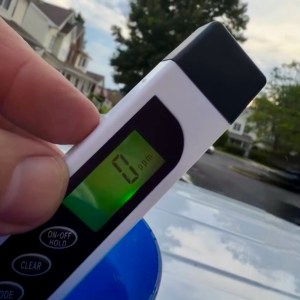
Recently, I tested the water coming directly from the outdoor faucet at our shop using a professional Total Dissolved Solids (TDS) meter.
The reading came back at:
63 Parts Per Million (PPM)

For comparison, the same meter measured 0 PPM after the water passed through our deionization system.
It’s important to understand what this means.
A reading of 63 PPM doesn’t mean Fort Mill has “bad” water. In fact, it’s perfectly safe drinking water.
It simply means that the water contains dissolved minerals.
Those minerals don’t disappear when the water dries.
They stay on your paint.
Every time.
Why We Pay Attention to TDS
Most vehicle owners have never heard of Total Dissolved Solids.
Professional detailers think about it constantly.
TDS is simply a measurement of how many dissolved minerals are suspended in the water.
The higher the reading, the more material is left behind after evaporation.
That’s why many professional detailing shops monitor water quality as closely as they monitor polishing temperatures, paint thickness, or chemical dilution ratios.
It’s another way to reduce unnecessary risk during the detailing process.
Why Summer Makes Water Spots Worse
If you’ve ever noticed water spots appearing almost immediately after washing your vehicle, summer heat is usually the reason.
Here in the Carolinas, surface temperatures on dark-colored vehicles can easily exceed 140-150°F in direct sunlight.
That means rinse water begins evaporating almost as soon as it touches the paint.
Even experienced detailers can struggle to dry every panel before evaporation begins if they’re using untreated tap water.
Once the water disappears, the minerals remain.
This is why customers are often surprised to find water spots after what seemed like a perfectly good wash.

Sprinkler Systems Are One of the Biggest Culprits
Ironically, many of the worst water spots we remove didn’t come from washing the vehicle at all.
They came from lawn sprinklers.
If your vehicle is parked in the driveway every morning while the irrigation system runs, mineral-rich water repeatedly lands on the same panels.
The Carolina sun quickly evaporates the moisture, leaving fresh deposits behind.
Day after day.
Week after week.
Eventually those minerals begin bonding more aggressively to the clear coat.
We’ve seen vehicles where customers thought the paint had permanently failed, when the real issue was years of sprinkler overspray.
When Water Spots Become Paint Damage
Fresh mineral deposits usually sit on top of the paint.
That’s the good news.
The bad news is what happens when they’re ignored.
Repeated heating and cooling cycles allow those minerals to become increasingly stubborn. Eventually, they can begin etching into the clear coat itself instead of simply resting on the surface.
At that point, a wash won’t fix the problem.
Professional paint correction is often required to safely remove the etching and restore clarity.
That’s why we always tell customers that preventing water spots is far less expensive than correcting them later.
Why We Invested in a Deionized Water System
This is one of the biggest differences in our wash process.
Before any water reaches your vehicle, it passes through our professional deionization system.
Inside the system is specialized resin that removes the dissolved minerals responsible for water spotting.
The filtered water is then stored in our onboard 100-gallon tank and transported directly to your appointment.
When we test that water, it consistently reads:
0 PPM.
That means virtually none of the minerals responsible for water spots remain.
If a panel begins drying before we can towel it off—even on a scorching Carolina afternoon—it isn’t leaving behind the same mineral deposits that untreated tap water would.
No, deionized water doesn’t make us immune to every environmental factor. Dust, pollen, and other contaminants can still settle on a vehicle. But removing dissolved minerals from the wash process dramatically reduces one of the biggest causes of fresh water spotting.
Why We Don’t Hook Up to Your Garden Hose
Customers ask us this almost every week.
“You’re welcome to use our water.”
We truly appreciate the offer.
But we politely decline.
Not because your water is unsafe.
Because we have no way of knowing what’s in it.
Every neighborhood has different water chemistry. Some homes have relatively low mineral content. Others have significantly higher readings.
Rather than introducing that variable into the wash, we bring our own professionally filtered water every time.
It’s one of those details most customers never think about—but it’s one of the reasons our results remain consistent from one appointment to the next.
How to Reduce Water Spots at Home
Even if you aren’t using a deionization system, there are several ways to reduce the chances of water spots forming.
- Wash early in the morning or later in the evening when surfaces are cooler.
- Dry each section before moving on to the next instead of rinsing the entire vehicle first.
- Avoid parking where irrigation systems regularly spray your vehicle.
- Remove fresh water spots as soon as possible before they have time to bake into the paint.
- Consider professional maintenance washes if your vehicle has already begun developing stubborn mineral deposits.
Small habits like these can save you from much more expensive paint correction down the road.
Frequently Asked Questions
Can rain cause water spots?
It can. While rainwater itself is often relatively low in minerals, it can collect airborne contaminants before reaching your vehicle. Once on the paint, it mixes with dust, pollen, and existing mineral deposits, which may leave spotting as the water evaporates.
Will ceramic coating prevent water spots?
Not entirely.
Ceramic coatings make the surface easier to clean and often make mineral deposits easier to remove, but they don’t stop minerals from drying on the surface. Even coated vehicles should be washed and dried properly.
Can water spots permanently damage paint?
If caught early, most water spots can be safely removed. Left for weeks or months in direct sunlight, however, they may etch into the clear coat and require professional paint correction.
Is washing in the shade enough?
Washing in the shade certainly helps, but on a hot Carolina day, panels can still be warm enough for water to evaporate quickly. Proper drying techniques—and clean rinse water—are just as important.
The Little Things Make the Biggest Difference
Customers notice the glossy paint.
They notice the spotless wheels.
They notice the clean interior.
What they don’t always notice are the decisions happening behind the scenes that protect their vehicle before the final towel ever touches the paint.
Using deionized water isn’t an upgrade.
It isn’t an add-on.
It’s simply how we believe every vehicle should be washed.
There are plenty of ways to make a vehicle look clean for an afternoon.
Our goal has always been different.
We want it looking just as impressive tomorrow, after the sun comes out, after the sprinkler cycles run, and after the next maintenance wash.
Sometimes the biggest difference isn’t the wax, the polish, or the coating.
Sometimes it’s something as simple—and as overlooked—as the water.
Trust Absolute Precision Custom Detailing for Spot-Free Results
If you’re looking for professional mobile detailing in Fort Mill, Charlotte, Indian Land, Lake Wylie, Rock Hill, Tega Cay, Waxhaw, Weddington, Clover, or the surrounding communities, we’d love the opportunity to show you why our process is different.
From using deionized water and premium detailing products to following paint-safe washing techniques, every step is designed to protect your investment—not just make it shine for a day.
Whether you need a maintenance detail, paint correction to remove existing water spots, or long-term protection with a ceramic coating, we’re committed to doing the job the right way from the very first rinse.
Prefer to chat first? No problem, Contact Us Here or Call us at 704-654-2042